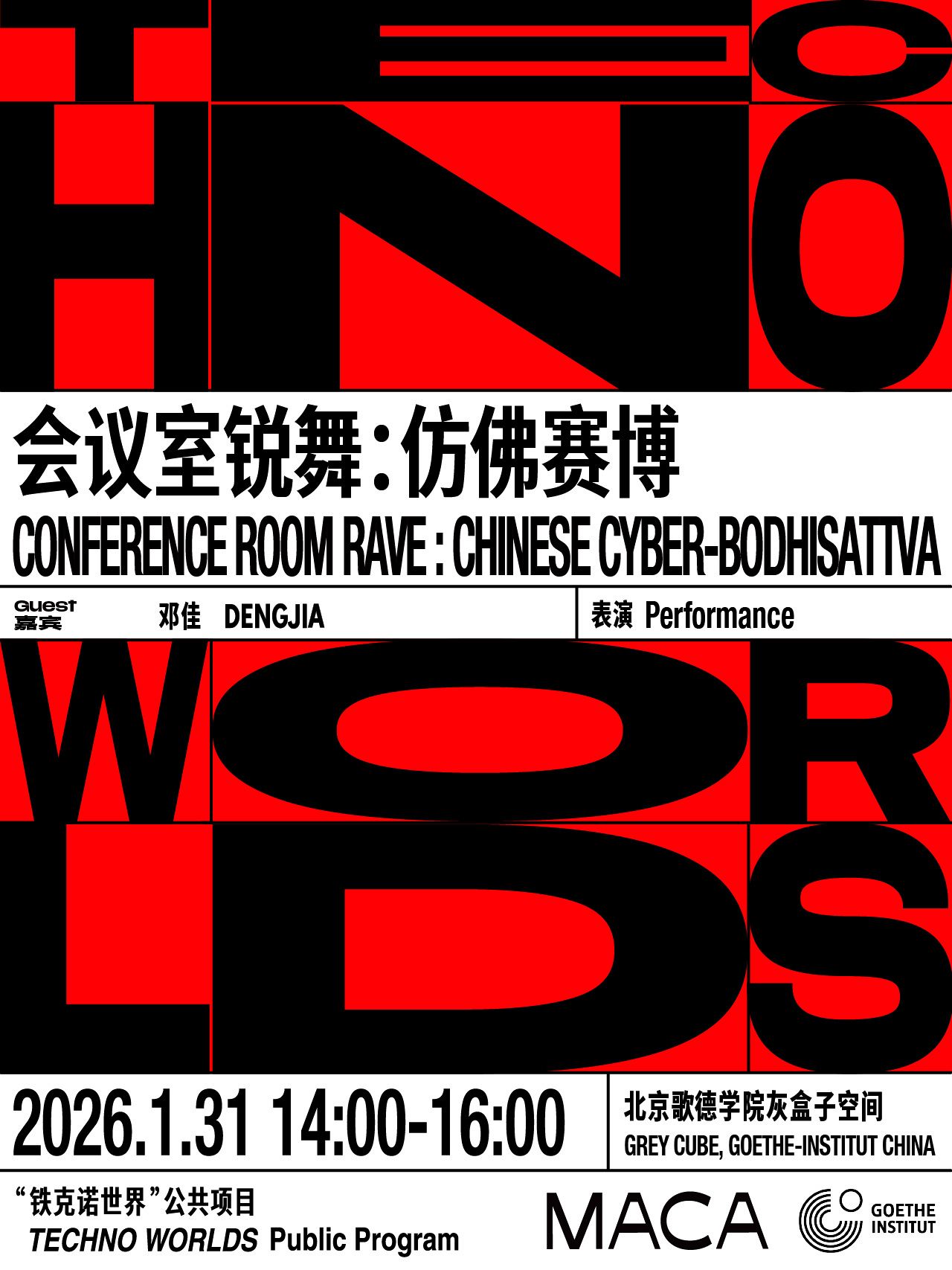
TECHNO WORLDS
Conference Room Rave: Chinese Cyber-Bodhisattva
2026.01.31 Saturday 14:00
Location
Grey Cube, Goethe-Institut China
Guest: DENG JIA
“Cyber Bodhisattva” electronic music has gradually crystallized into a widely recognized subcultural label within the Chinese internet sphere. Coined and shaped by online communities, the term refers to a listening experience in which spirituality and technological sensibilities intertwine. This event specially invites Dr. Deng Jia as a guest to examine the mechanisms behind the formation of this label, its modes of audience reception, and the forms of community bonding it enables, shedding light on emerging configurations in which music, religion, and digital culture converge in contemporary contexts.
Conference Room Rave is a time-limited weekly experience taking place in the Goethe-Institut’s Grey Box space. The Grey Box temporarily returns to its original role as a meeting room, and every Saturday from 2:00 to 4:00 pm, audiences are invited to bring the underground rhythms of the night into everyday life. With sound and bodies present, perhaps any space can become a dance floor.
About the guest: DENG JIA
Deng Jia is a postdoctoral fellow in musicology at Peking University (Beijing, China). She received her PhD degree in musicology from the China Conservatory of Music (Beijing, China) in 2024. Her research explores topics in Western music history, modern Chinese music history, and music aesthetics, with a recent focus on experimental music and contemporary Chinese electroacoustic music.