2025.11.08 Saturday 19:00
Location
Fotografiska, No.127 Guangfu Road, Jing’an District, Shanghai
Artist: Hu Rui
Speaker: Hu Fangqi
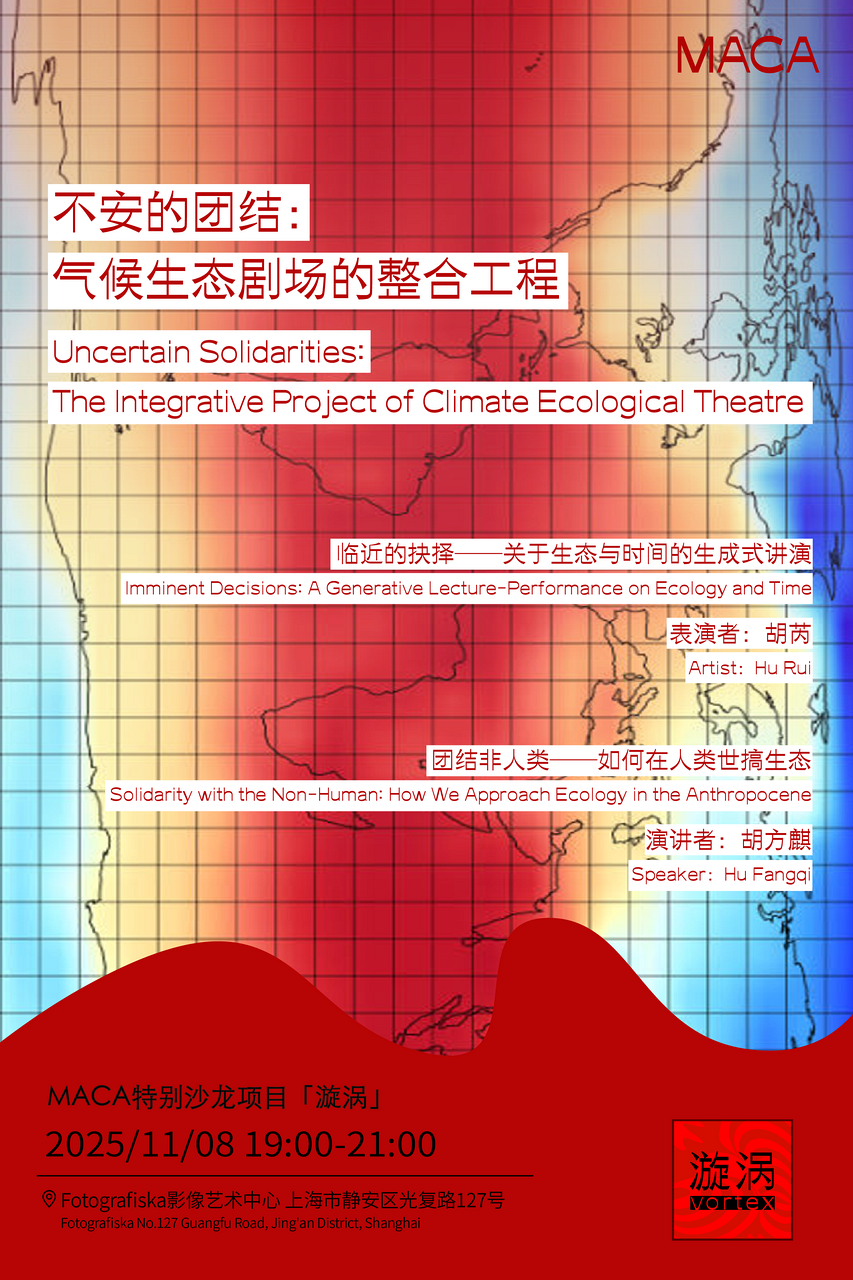
Imminent Decisions: A Generative Lecture-Performance on Ecology and Time
Artist: Hu Rui
“Nature builds no machines, no locomotives, railways, electric telegraphs, self-acting mules etc. These are products of human industry; natural material transformed into organs ... of human participation in nature.”
—Karl Marx
Hu Rui's lecture-performance is devised upon a science fiction setting that also serves as the backdrop for one of his recent works. Sci-fi proves to be a remarkably versatile container, for it can be simultaneously accurate, prophetic, political, emotional, non-doing (wu wei), and fabricated. It is within this premise that the artist asks for permission to establish the following setting and scenario: The climate crisis was deemed inevitable, yet its urgency seemed distant until a certain threshold year. After extensive research on radical geo-engineering projects guided by the principle that “what’s technical is also natural,” and facilitated by AI supercomputing simulation, the Urban Planning Committee of a coastal city convened a series of conferences.
Two competing options emerged from the committee: 1) Abandon protective measures against rising sea levels, and instead begin allowing sea water into the city and build floating communities on the new water territory; 2) Implement a comprehensive “rewilding” whereby plants and algae cover all ground surface including roads, streets, and architecture, allowing the vegetation coverage to return to its pre-industrial levels. Advocates of the two proposals engaged in a final discussion during the plenary meeting that followed.
This generative lecture-performance, developed and conducted in collaboration with artificial intelligence, revisits three narrative fragments stored within the participants’ brain-computer interfaces, revealing a psychic state that drifts between scientific decision-making and the internal stream of consciousness under the condition of crisis.
Solidarity with the Non-Human: How We Approach Ecology in the Anthropocene
Speaker: Hu Fangqi
We’ve already done it! The ecological issue is a hornet’s nest we stirred up long ago. But now, our naïveté threatens our own downfall: we still continue to act like the experts evaluating risks from a distance, all encased in masks and isolation gowns, striving to come up with solutions through accusation and finger-pointing. What must be grasped is that the world is never isolated beyond our protective gears; rather, we are with the hornets, trapped and sealed within the masks meant to shield us.
These hornets are the non-humans we assumed we had successfully quarantined. To approach ecology in the Anthropocene means removing the haughty protective gears of anthropocentrism, seeking a new mode of symbiosis, and rebuilding solidarity with the non-human multitudes we once regarded as mere targets of the united front. This new mode is destined to be ultimately spectral, quantum, and simultaneously ecological and artistic.
Hu Rui works with video, installation, and computer simulation. His practice engages with issues related to time and temporality from a multitude of perspectives, such as causation, prediction, choice, and language. He is the recipient of the Best Experimental Animation Award at the 60th Ann Arbor Film Festival and a Jury Special Mention at the 25FPS Festival Croatia. His work has been shown in exhibitions and screenings at art spaces, institutions, festivals, and conferences, including the International Film Festival Rotterdam; UCCA Center for Contemporary Art, Beijing; IFVA at the Hong Kong Arts Centre; Times Museum, Guangzhou; Three Shadows, Xiamen; Objetifs, Singapore; Start Museum, Shanghai; Wuhan Biennale; Siggraph Asia; ISEA, among others. He received an MFA in Design Media Arts from the University of California, Los Angeles, and a BFA in Film and Television with a minor in Computer Science from New York University. He is currently Assistant Professor in Computation and Design at Duke Kunshan University.
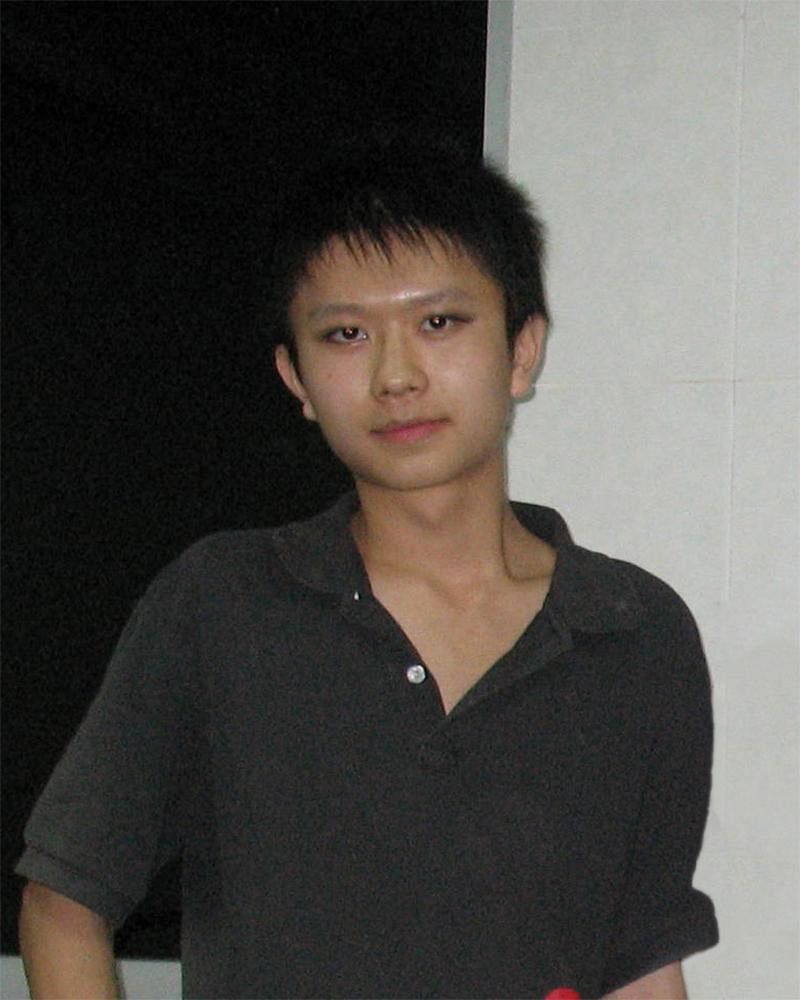
Born in Changchun, Jilin Province, Hu Fangqi holds a BA in Chinese Literature from Xiamen University and M.A. in Literary Theory from Tongji University. He currently works as a freelance translator and writer while pursuing his PhD in Philosophy at Tongji University. His academic focus is on Western contemporary philosophy and aesthetics, with primary research centered on the non-anthropocentrism and ecological thoughts pioneered by Timothy Morton under the perspective of Object-Oriented Ontology (OOO).
VORTEX, launched by the MACA in Shanghai in 2022, is an art and cultural salon in the form of lecture performances occurring once or twice every month. The programme calls for non-institutionalised artistic and academic production in which contemporary art practitioners and scholars get to explore cross-disciplinarily the issues of the macro or micro, the global or local, the collective or individual. VORTEX, hence, is where you spin in the whirlpool of spontaneous whims and intuitive approaches represented by individual research and enquiries. Being present here at VORTEX, you are experiencing versatile forms of lecture performances that experiment with new mechanisms and methodologies.