 Dorota Gawęda and Eglė Kulbokaitė: Spit and Image
On Becoming an “Art Monster”
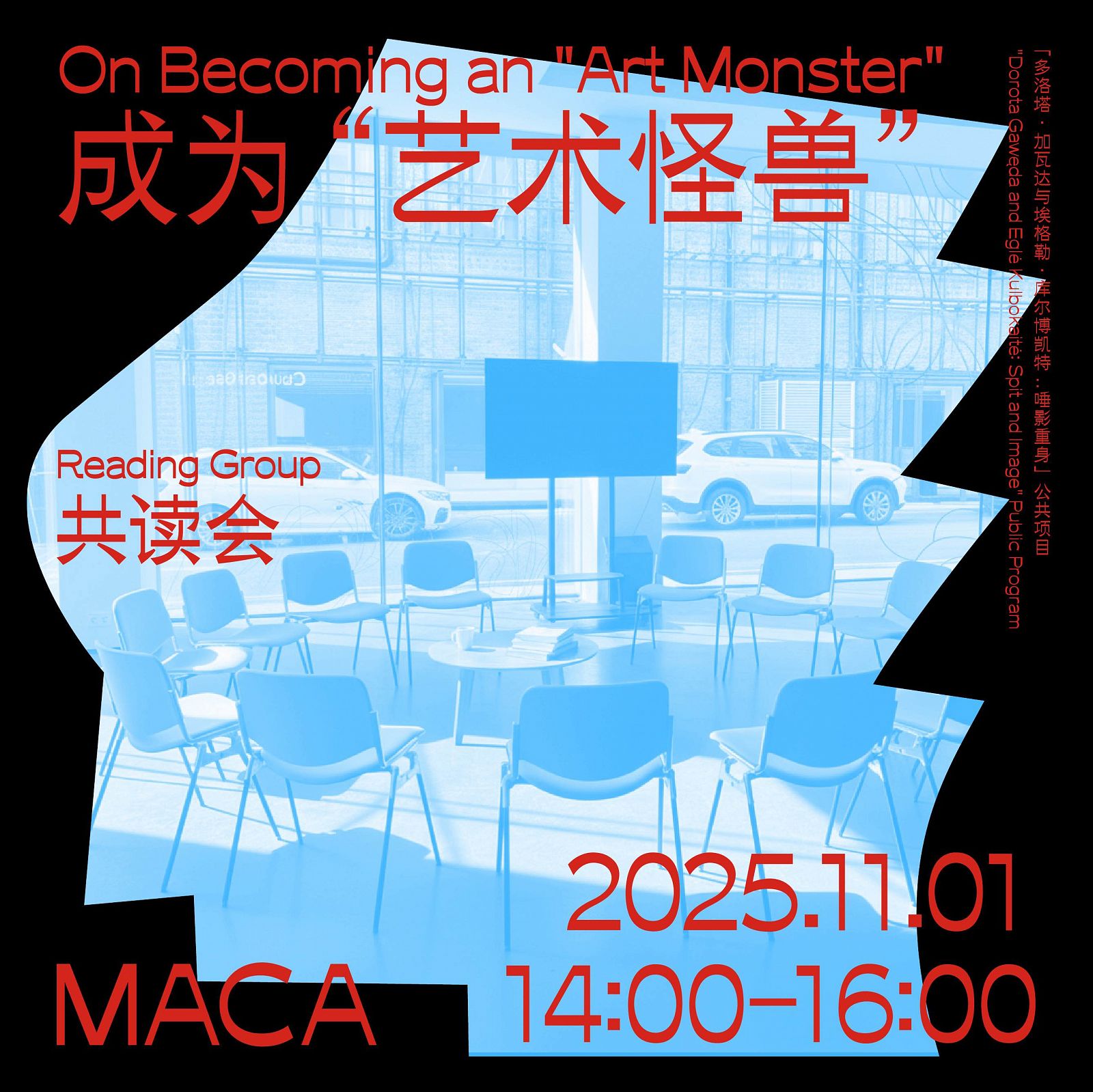
2025.11.01 Saturday 14:00
Location
MACA Art Center
What does the body become in art when it refuses to be docile, beautiful, and whole?
In MACA's current exhibition Spit and Image, artists Dorota Gawęda and Eglė Kulbokaitė present a series of unruly bodies: the two-souled upiór, mutant flesh oscillating between horror and the sacred, and the doppelgänger in the digital fog. These figures are precisely the "monsters" that author Lauren Elkin contemplates in her book Art Monsters—those that refuse definition, spill over boundaries, and are filled with power.
In Art Monsters, Lauren Elkin uses the slash symbol ( / ) as a starting point to propose a "slash aesthetic" full of contradictory tension. The slash, she argues, can both divide and connect; it can sever and build bridges. In the exhibition Spit and Image, the artists' exploration of "doubleness" and "in-betweenness" resonates powerfully with this metaphor.
One of the main strategies of the "art monster" is articulation—a creative practice achieved through splicing and reassembling. This strategy is expressed through actions that "disrupt, blast, and overturn" systems, refuse to be silenced, and retell the body's narrative in unique ways. In the book, Elkin uses the work of artist Eva Hesse as an example to reveal how articulation becomes a methodology. Through reorganization, collage, and reconnection, it allows fragmented experiences to regain the possibility of expression.
This theoretical perspective offers an insight into understanding Spit and Image. The exhibition employs a mode of articulation by patching together heterogeneous elements such as Slavic mythology, internet memes, chemical concepts, and body horror. In doing so, it constructs a unique aesthetic structure that navigates the space between "tearing" and "suturing," responding to the creative path of the "monster" that Elkin describes.
We invite you to join MACA's reading group to dive deep into the text of Art Monsters and explore the feminist aesthetics of the "monster" within Elkin's writing.